


Insurance Claims for Boarding Up in Slough (SL Postcodes)
If you’re dealing with a break-in, vandalism, storm damage or an accidental impact, you’re probably juggling police, landlords/tenants, and an insurer—while trying to make the property safe. We provide boarding up in Slough and across the SL postcode area, and we can supply the practical documentation insurers typically ask for after emergency securing works.
We’re not loss adjusters and we can’t approve claims or tell you what your policy will pay. What we can do is secure the building quickly and professionally, then give you clear evidence of what was done and why—so your insurance claim has the best chance of moving smoothly.
For urgent help, see emergency boarding up or call 01753 379 919.
When do you need boarding up for an insurance claim?
Insurers usually expect you to take “reasonable steps” to prevent further damage or theft after an incident. In practice, that often means boarding up a broken or vulnerable opening—especially if the property will be unattended overnight or over a weekend.
Common claim-related call-outs we see across Slough (SL1–SL3) and nearby areas include:
- Burglary and attempted break-ins (splintered doors, jemmied frames, smashed side panels)
Related help: burglary repairs and boarding up - Vandalism to shopfront glazing or ground-floor windows (often after-hours)
Related help: vandalism repair and boarding up - Storm damage (blown-in windows, dislodged panels, damaged rooflights)
Related help: storm damage boarding - Accidental impact (vehicle strikes to low walls, windows, shopfronts; scaffold knocks)
Related help: accident damage boarding - Post-fire securing once the fire service has finished (windows/doors compromised, access points exposed)
Related help: fire damage securing
If you’re unsure whether boarding is “allowed” under your policy, it’s still usually sensible to secure the opening first and notify your insurer as soon as possible. If you’re able, take photos before any works begin.
What insurers typically want (and what we provide)
Insurance paperwork varies, but most claims handlers want a clear record showing:
- What happened (briefly: break-in, vandalism, storm, impact)
- What was damaged (which openings, approximate sizes, extent of frame damage)
- What you did to prevent further loss (boarding, temporary security)
- When it was done (date/time)
- What it cost (itemised invoice)
After boarding up, we can provide:
- Itemised invoice describing labour, materials and method (where appropriate)
- A concise statement of works (what we attended for and what we secured)
- Time-stamped photos before/after (and during, where helpful)
- Notes on access and constraints (e.g., upper-floor access, safe fixing points, frame condition)
If a frame is too damaged for non-destructive fixing, we’ll explain the options before proceeding. Sometimes the safest approach is a more robust fix, especially for ground-floor openings that face public areas or footfall.
The key thing: make the property safe and secure first
In Slough, a broken window or forced door can be a magnet for repeat attempts—particularly on exposed elevations, near alley access, or where the opening is visible from the street. Whether it’s a terraced house near the A4/Bath Road corridor, a flat above a parade of shops, or a unit on an industrial estate, the priority is the same:
- Stop unauthorised access
- Reduce weather ingress
- Create a clear record of what was done
If you need immediate attendance, go straight to 24 hour boarding up in Slough.
How our boarding-up work supports your claim (materials & method)
We match the method to the opening, the risk level, and how long you need the property secured.
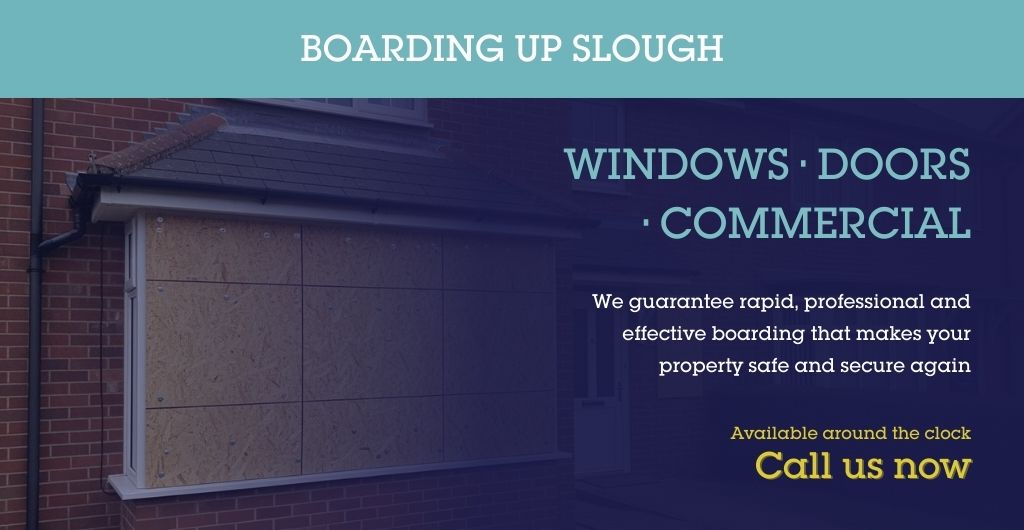
Windows: plywood or OSB, sized and fixed correctly
For many residential and commercial windows, we use:
- 18mm exterior-grade plywood for strength and better screw-holding
- 12mm OSB for smaller/less exposed openings where appropriate
Fixing method depends on the frame condition and access. Where possible, we use anti-tamper fixings to make removal from the outside far harder—important when a property is vacant or the opening is at ground level.
See: window boarding in Slough
Doors: boarding up vs temporary steel doors
If a door leaf is split, locks are destroyed, or the frame is compromised, boarding alone may be a short-term patch. For medium-term security—especially for vacant properties, repossessions, or where trades are coming and going—a temporary steel door is often the most sensible option.
Shopfronts and commercial glazing
Retail and trade premises often need a more robust approach because openings are larger and more exposed. We board up shopfronts in a way that prioritises:
- Public safety (sharp edges, loose glazing, trip hazards)
- Strong external resistance
- A clear work description for the insurer/facilities team
See: shopfront boarding in Slough
Roof openings and skylights (weather and access challenges)
Roof damage is stressful because the risk of water ingress can escalate quickly. We secure rooflights and vulnerable openings where safe access is possible, and we’ll be upfront if specialist access (scaffold/MEWP) is required before work can be done safely.
What to do before you call (if it’s safe)
A claim is easier when key information is captured early. If there’s no immediate danger:
- Take clear photos of the damage and any relevant surroundings (from inside and outside)
- Don’t touch evidence if it’s a burglary—police may need to examine the scene
- Find your policy details and the insurer’s out-of-hours number
- Get a crime reference number (if police attend or you report it)
If there’s glass on a public pavement or the opening presents immediate danger, keep people away and call for urgent help.
What happens when you call us
When you contact Boarding Up Slough, we’ll ask a few practical questions so we can bring the right materials and fixings:
- Property type (house/flat/shop/unit) and whether it’s occupied
- What’s damaged (window, door, shopfront, rooflight)
- Approximate size/quantity of openings
- Any access issues (rear access, height, shutters, shared entrances)
- Whether police/fire service/management company are involved
We don’t quote guaranteed arrival times—traffic, weather and job overruns happen—but we prioritise genuine emergencies and keep communication straightforward.
If you’re calling for urgent assistance: Call 01753 379 919.
Working with landlords, managing agents and facilities teams
Insurance claims on rented or commercial property can be complicated by responsibilities—tenant vs landlord, freeholder vs leaseholder, or a managing agent overseeing multiple sites.
We can help by providing:
- A clear scope of works for the claim file
- Photos suitable for facilities reporting
- An invoice that matches the site and unit details (useful for multi-site portfolios)
For voids between tenancies, longer-term options may be more cost-effective than repeat boarding. See: vacant property boarding up.
Will my insurer pay for boarding up?
It depends on your policy, excess and the circumstances. Boarding up is commonly treated as an emergency “make safe” measure, but the only definitive answer comes from your insurer.
What we can do is make sure your paperwork clearly shows:
- The opening was vulnerable
- The work was reasonable and proportionate
- The property was left secure to reduce further loss
If you’re trying to understand cost drivers before you proceed, you can also read: boarding up pricing.
Common insurance-related scenarios we see in Slough (SL)
Slough has a real mix: Victorian terraces, 1930s semis, big post-war estates, newer apartment blocks, and busy trading areas. The type of damage (and the best “make safe”) differs depending on the building.
- Ground-floor windows on busy routes can be at higher risk of repeat attention if left exposed.
- Flats above shops can have tricky access and shared entrances—good documentation matters for managing agents.
- Industrial units often have wider openings, roller shutters and mixed construction—fixing points need to be chosen carefully.
If your situation matches one of these events, you may find it easier to start with the event page and work forward:
- After a burglary: what happens next
- After vandalism: securing your property
- After storm damage: temporary securing
FAQs about insurance claims and boarding up in Slough
Should I call my insurer before arranging boarding up?
If you can reach them quickly, it’s helpful—but don’t delay making the property safe if the opening is exposed. Take photos first if safe, then secure the property and notify your insurer as soon as you can.
What details do you put on the invoice for my claim?
We include the service type (e.g., window/door/shopfront boarding), the address, date, and an itemised description of materials and labour. Where useful, we can add brief notes about the damage and why a particular method was used.
Can you board up without causing extra damage?
We aim to use the least destructive method that still provides proper security. If the frame is heavily compromised, we’ll explain the realistic options before proceeding—sometimes a stronger fixing is necessary to make the building safe.
I’m in the SL postcode area but not in central Slough—do you cover me?
Yes. We work across Slough and the wider SL postcode area. If you’re unsure, check areas we cover or call to confirm.
Do you handle the full repair (new glazing/door replacement) as part of the claim?
Our role is typically the make-safe and security stage. We can secure the opening and provide documentation; full reinstatement is usually handled by a glazier, builder, or the insurer’s approved contractor.
Ready to move your claim forward?
If you need documentation-friendly boarding up after an incident, we’ll secure the property and provide the photos and paperwork insurers typically request.
Ready to get started? Call 01753 379 919 or email us for a free, no-obligation quote.
